 © Shutterstock
Overview
The Western Ghats host one of the largest contiguous forested landscape, which is home to Bengal tigers and Asian elephants. As a biodiversity hotspot, it supports many endemic species, including the Nilgiri tahr, lion-tailed macaque, Nilgiri langur and Malabar grey hornbill. The landscape is also renowned for the mass flowering of Neelakurinji (Strobilanthes kunthiana), which blooms once every 12 years, transforming large stretches of the terrain into a striking blue landscape.
Rivers and wetlands are integral to the landscape and home to aquatic species such as humpback mahseer, mugger crocodiles and otters. The region encompasses the major headwaters of the Kaveri River’s tributaries, including the Noyyal, Bhavani and Amaravathi, making it vital to downstream water security and the livelihoods of millions.
Diverse anthropogenic pressures, including land-use change driven by unplanned agricultural expansion and urbanisation, extractive activities and unplanned development, are the leading causes of habitat degradation and fragmentation across the landscape. The proliferation of invasive species and climate change further exacerbate these pressures by altering ecosystem structure, reducing native biodiversity and disrupting ecological processes. These cumulative impacts intensify human–wildlife conflict, particularly involving wide-ranging species such as elephants, and also affect the integrity of river systems and downstream water security.
 © WWF-India
OUR WORK – WESTERN GHATS NILGIRIS LANDSCAPE
In this landscape, a strong emphasis has been placed on implementing inclusive conservation approaches, which focus on the facilitation of Community Forest Rights.

KEY PILLARS OF OUR WORK:
-
WWF-India has been instrumental in identifying and securing elephant corridors through assessments, evidence generation and advocacy. It focuses on protecting two critical wildlife corridors in Tamil Nadu: the Segur corridor, which links the Mudumalai Tiger Reserve with the Nilgiri Hills, and the Kallar corridor, which connects the Bhavanisagar range with Kallar and Athikadavu. Conservation efforts in these corridors include regular monitoring and threat assessments, collaboration with local stakeholders to reduce and eliminate disturbances, and legal and policy advocacy to ensure long-term protection.
-
Through research, monitoring and community-based conservation in the Western Ghats, WWF-India has played a significant role in conserving the Nilgiri tahr, the state animal of Tamil Nadu, and in facilitating the establishment of the Government of Tamil Nadu’s Project Nilgiri Tahr.
-
WWF-India has been actively involved in the recovery of key wildlife species, such as the Bengal tiger and the Asian elephant, through population monitoring and by supporting state forest departments with hands-on training in ecological monitoring, species identification, camera trapping, protection and law enforcement. Additionally, WWF-India supports anti-poaching efforts by identifying high-risk areas and helping establish anti-poaching camps.
- Human–elephant conflict has been a major challenge for communities living near protected areas. WWF-India has been addressing this by mapping conflict hotspots, analysing underlying causes and implementing pilot interventions to manage the human–elephant interface, including strengthening community-based barriers and radio-collaring elephants.
- WWF-India has introduced incentive-based compensation mechanisms to offset losses and reduce retaliatory killing of large carnivores in conflict situations. These are implemented in partnership with state forest departments and local community institutions to ensure the sustainability of the efforts.
- WWF-India has worked with the state government to develop hotspot management plans with timely recommendations to reduce human-elephant conflict in the area. To safeguard lives, property and crops, WWF-India also deploys innovative solutions, such as secure public distribution storage (containers), early warning systems and AI-enabled monitoring technologies.
- WWF-India has focused its efforts on the Noyyal-Bhavani river basin, working to improve the health of this river ecosystem to ensure water security for people and nature. It has undertaken hydrological modelling, seasonal river health assessments (including water quality testing), environmental flows, wetland conservation, catchment restoration, pollution hotspot mapping, springshed studies and improved management of industrial and urban water, with support from like-minded partners. WWF-India works with 80 textile industries on clean-tech interventions.
- WWF-India has also developed wetland management plans with stakeholders such as local NGOs, farmer groups and fisher groups to pilot wetland conservation initiatives using citizen science in selected areas. The organization is planning to scale up this initiative in the Noyyal River Cascade Wetlands, with active engagement of partners and communities.
- Under the SAIM (Sustainable Approach for Integrated Waste Management) Project, WWF-India is working with local bodies and government stakeholders to strengthen scientific solid waste management systems through baseline assessments, stakeholder convergence, awareness programmes and recovery-focused interventions.
- WWF-India has identified degraded tiger and elephant habitats using science-based approaches, supported the sustainable removal of invasive species from forests, developed value-added solutions through invasive species, and supported institutions in restoring habitats to their native form by strengthening native plant and grass nurseries.
- WWF-India has helped in creating the Invasive Species Policy introduced by the Government of Tamil Nadu. This is the first of its kind in India.
- WWF-India's Marlimund high-altitude grasslands shola restoration project is a unique initiative that brings together multiple stakeholders to protect wetlands and recognise the traditional grass varieties maintained by the Toda tribal communities in the Nilgiris. The project focuses on restoring the fragile shola–grassland ecosystem of the Nilgiris, combining ecological restoration with community knowledge.
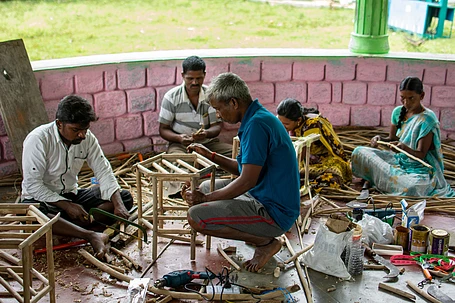
- WWF-India has been supporting the TAMS Tribal Green Fuels Pvt. Ltd. initiative, a tribal enterprise that produces briquettes from Lantana camara removed from the tiger reserve, thereby enabling habitat restoration and long-term forest management in alignment with the Forest Rights Act (FRA), Gram Sabhas and local community institutions. It has facilitated community-based enterprise development, strengthened partnerships between tribal groups and forest agencies, and promoted sustainable management of invasive species. Additionally, WWF-India is exploring mechanisms such as Biodiversity Credits to support long-term, scalable management of invasive species across the landscape.
- WWF-India has been a pioneer in building strong, active local institutions for forest governance and in promoting Community Forest Resource Rights (CFRR) under the Forest Rights Act, 2006. The objective is to enhance community stewardship of wildlife and habitats, with approximately 508 sq. km. brought under CFRR and co-managed by local communities for sustainable natural resource conservation.
 © shutterstock.com
Support Conservation
Your contribution helps us in protecting wildlife, restoring habitats and building a better future for people and nature.
Donate