 © Mohit Nagarwal/shutterstock.com
Overview
India is home to 12 major river basins, including the Ganga-Brahmaputra-Meghna, Indus, Narmada, Tapi, Godavari, Krishna, Kaveri and Mahanadi, which together encompass hundreds of rivers. India has about 2,31,195 (>2.25 h) wetlands with a total wetland area of 15.98 million hectares, accounting for nearly 4.86% of the country’s total geographical area. Rivers are deeply intertwined with Indian culture. Also critical to the economy, rivers and wetlands provide livelihood opportunities, food, freshwater and energy. They play an essential role in ensuring nutrient, freshwater and sediment flows and groundwater recharge. Rivers and wetlands, including lakes, inland deltas, swamps and marshes, coexist and sustain each other through hydrological and biological exchanges. However, many rivers and wetlands across the country are degraded and facing mounting pressures. In fact, in the last 100 years, India has lost more than 50% of its wetlands.
Habitat loss due to encroachment, catchment degradation, land conversion for farming, development and construction of infrastructure, over-extraction of water for irrigation, spread of invasive species, and climate change-related risks such as erratic rainfall, droughts and melting glaciers are threatening India’s rivers and wetlands.

OUR WORK – RIVERS & WETLANDS
Over the years, WWF-India has scaled up its efforts through intensive stakeholder engagement to include work on securing environmental flows in critical river systems, promoting inclusive management of wetlands and agricultural water use, and tributary rejuvenation with climate-informed planning. The programme promotes the use of nature-based solutions in urban and peri-urban areas, employs technology for conservation and water-footprint reduction, and builds partnerships across entire basins, including with major industrial sectors.
At the core of its work is a multistakeholder-led collective action approach for the management and governance of rivers and wetlands. This involves sustained stakeholder engagement, partnerships, scientific research, training, capacity-building initiatives and practical demonstrations. The stakeholders include central and state governments, ministries, district administrations, line departments, farmers, local communities, industries and subject matter experts.

KEY PILLARS OF OUR WORK:
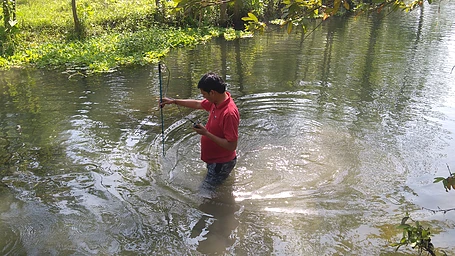
- WWF-India uses a holistic and multi-stakeholder river basin management approach to support the conservation of rivers and wetlands across the country. It focuses on protecting and conserving priority river systems and wetlands through better planning, policy advocacy and science-based action on the ground. It promotes wider adoption of environmental flows, closer attention to groundwater, and tributary rejuvenation that links different parts of a basin—all guided by climate-informed strategies and an ecosystem-services approach. WWF-India is working in river basins like Ramganga-Ganga, Chambal-Yamuna, Arkavathy, Noyal-Bhavani and Beas-Sutlej.
- WWF-India’s on-ground action is directly helping about 1,500 kilometres of rivers, while research and policy engagement is underway with state and central government departments—with the objective of improving the management of over 6,000 kilometres of rivers in India.
WWF-India works towards conserving and improving the habitats of freshwater species, such as gharials, Ganges river dolphins, turtles and otters in key river systems. It also works on stabilising their population through species reintroduction programmes, mitigation of threats (including unsustainable fishing), securing environmental flows and engaging communities to act as local stewards for conservation—as Nadi Mitras. The programme highlights how e-flows patterns, habitat quality and species recovery are interconnected, strengthening a holistic approach to river conservation.
- WWF-India has been engaged in wetland conservation for over four decades. It has served as a knowledge partner to the Ministry of Environment, Forest and Climate Change (MoEFCC) since 2018, providing technical support to 11 states and Union Territories (UTs).
- WWF-India was designated as the NGO CEPA Focal Point under the Ramsar Convention in 2019. It has contributed to the designation of 36 Ramsar Sites across 17 states. The organization has provided technical support in developing Management Plans for 22 sites, covering over 4,97,942 hectares across 10 states and UTs, including 16 Ramsar Sites. WWF-India also contributed to Udaipur’s accreditation as a Ramsar Wetland City (2025), one of two Ramsar-accredited cities in India. It also supported the designation of two conservation reserves—the Greater Hesaraghatta Grassland Conservation Reserve and the Beas Conservation Reserve.
- WWF-India regularly provides support to national programmes and schemes, including the National Plan for Conservation of Aquatic Ecosystems, 100 Days Wetland Rejuvenation, Amrit Dharohar and Mission Sahbhagita, among others.
- In 2023, WWF-India supported in the conceptualisation, development and implementation of the Save Wetlands campaign, including preparation of 130 brief documents, 670 wetland cards, enrollement of over 4,900 Wetland Mitras and sensitisation of more than 21,000 people. It has undertaken a study of carbon dynamics at the Aghanashini Estuary (Ramsar Site) and six other wetlands in Karnataka as part of the Amrit Dharohar initiative. It also supported the documentation of 4,000 wetlands in Karnataka, 1,190 in Punjab and 192 in Uttarakhand, alongside capacity-building programmes for wetland managers and nature guides. WWF-India remains committed to supporting MoEFCC for strengthening resilience and promoting wise use of wetlands.
WWF-India promotes responsible water use and joint action to improve ecosystem health across major river basins. It brings together various stakeholders (urban water users, industry managers, retailers, financial institutions, regulators and government officials) to facilitate collective action that leads to effective river basin management.
WWF-India has collaborated with industrial clusters in the metalware, leather and textile sectors to promote better water-use practices, support cleaner technologies and reduce pollution and water footprint. City-level collective action brings together industries and urban actors to address shared water risks. These models help improve basin-wide outcomes and strengthen the programme’s credibility and influence.
WWF-India has helped strengthen governance systems and enabled multiple stakeholders, including communities, to participate in managing and conserving freshwater ecosystems.
- WWF-India has supported effective institutions and progressive policies, drawing on the government’s focus on wetlands, the growing adoption of sustainable river basin management approaches—including restoration of environmental flows—and large-scale investments in conservation.
- Strategic partnerships upstream and downstream, along with regular assessment and planning, help align programme actions with changing needs and funding opportunities in landscape-scale initiatives.


 © shutterstock.com
Support Conservation
Your contribution helps us in protecting wildlife, restoring habitats and building a better future for people and nature.
Donate